Cornell, Mind Maps, and Outline Notes: Choosing the Right Method

Good note taking is less about writing more and more about choosing a structure that matches the task. A public shelf of useful reading can hold many guides, yet students still lose time when every lecture, reading, and study session receives the same treatment. This learning portal-style guide compares three dependable approaches so you can select the right tool before the timer starts.
The short version is simple. Cornell notes suit lectures and later review, mind maps reveal relationships between ideas, and outlines keep complex material in a clear hierarchy. None is universally best. The practical skill is recognizing what the material demands and what you will need to do with it after class.
How the three methods differ
Cornell notes: built for review
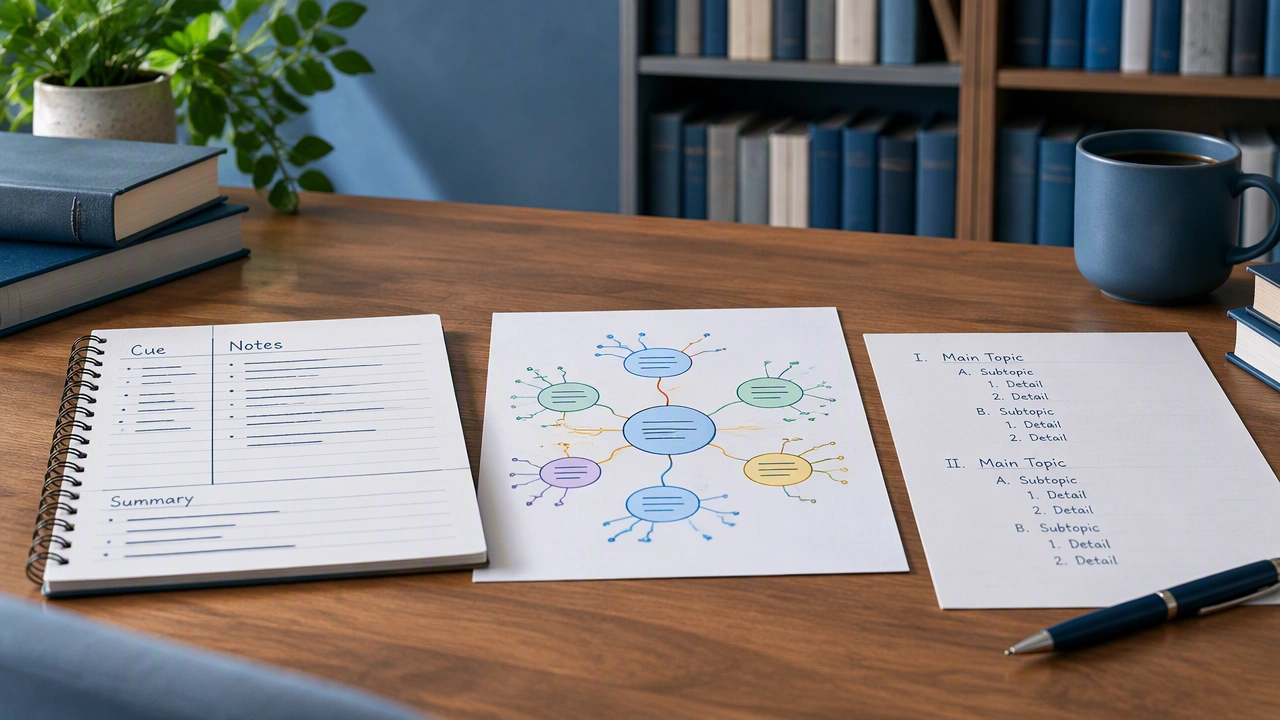
The Cornell system divides a page into three areas: a narrow cue column, a wider note-taking area, and a summary band at the bottom. During a lecture, you record ideas in the main area. Afterward, you turn the same material into questions, keywords, and prompts in the cue column, then write a brief summary that joins the pieces together.
This method shines when information arrives in sequence and you expect to revisit it. The cue column turns passive notes into an active study tool: cover the main notes, answer the prompts, and check your understanding without rereading everything. It also makes gaps visible. If you cannot form a useful question from a section, you probably do not understand it yet.
Cornell notes are less helpful when the lecture jumps between unrelated topics or when the instructor emphasizes connections rather than facts. In that case, the linear page can force a false sense of order. The method also asks for a short second pass. Students who never complete the cues or summary lose much of its value.
Mind maps: built for relationships
A mind map starts with a central concept and branches outward into subtopics, examples, and links. Words sit on lines, and color or symbols can mark categories. Because the page is spatial, related ideas can sit near one another even when they appear at different points in a lecture or chapter.
Mind maps are strong for brainstorming, planning essays, and connecting readings across a unit. They encourage you to ask, “How does this relate to that?” rather than simply recording what was said. When a subject is conceptual, such as a theory with causes, limits, and applications, the visual layout can make the structure memorable.
The trade-off is speed and detail. Fast-moving factual lectures can overwhelm a map with tiny branches, and long quotations do not fit neatly onto lines. Mind maps also depend on your ability to decide what belongs where. If you build them without a clear question, the result may look organized while hiding weak reasoning.
Outline notes: built for hierarchy
Outlines use indentation to show levels of importance. A main claim becomes a heading, supporting points sit beneath it, and examples or definitions fall one level lower. The format is familiar because it mirrors the organization of many textbooks, policies, and technical explanations.
Outlines excel when the material already has a clear order: a historical sequence, a legal rule with exceptions, a mathematical procedure, or a chapter divided into defined sections. They are fast to scan, easy to extend, and useful for turning notes into a study sheet or a draft. A numbered outline can also expose missing steps in an argument.
Outlines are weaker when ideas compete rather than nest. If two concepts interact across sections, a strict hierarchy may hide the connection. Students who outline too early can also copy the speaker’s order without deciding which points matter most, producing a tidy record that does not improve understanding.
Match the method to the task
For a steady lecture with definitions, examples, and a clear conclusion, Cornell notes usually provide the best balance of capture and review. For a discussion that links several theories or generates possible essay angles, a mind map helps you see the shape of the conversation. For a dense reading with steps, categories, or a legal-style structure, an outline keeps the logic visible.
Consider the output you need next. If you will quiz yourself tomorrow, choose a format that supports retrieval, such as Cornell cues. If you must compare authors or plan a paper, choose a map that can show cross-links. If you must explain a process or reproduce a hierarchy, choose an outline with numbered levels.
Time pressure matters too. Cornell notes require a deliberate cleanup pass, mind maps need branching decisions, and outlines reward quick indentation. Pick the method you can finish while the ideas are fresh, then refine it later rather than abandoning it halfway.
A simple classroom routine
Before the session, write one question you want the notes to answer. During the session, capture claims, evidence, and examples in the format that fits the question. After the session, spend five minutes testing the notes: close the page, recall the main points, and mark what you missed.
For exams, use the same notes in different modes. Turn Cornell cues into flash questions, rebuild a mind map from memory, or re-outline a chapter without looking at the original. The change of format forces retrieval and reveals whether you know the material or merely recognize it.
What to keep on the shelf
No method replaces attention, but the right structure reduces friction. Keep a Cornell template for lectures you must review, a blank sheet for visual mapping, and a simple outline format for structured readings. Rotate them deliberately instead of defaulting to one page style.
The aim is not to produce beautiful notes. It is to leave a trail that lets you reconstruct thinking quickly. When the method matches the task, you spend less time organizing later and more time recalling, explaining, and applying what you learned.